Wednesday, July 18, 2012
The 20 MPH Gear
I've been working hard on getting a lot of time on the saddle this season, biking about 50 - 60 miles a week on average. If you've read my blog before (I know, it's been a long time), you may have read about my cycling a bit. Due to a running sprain earlier this year (Tendonitis, ouch!), 34 or 35 miles in one ride is about all my left foot can handle. Needless to say, century rides are pretty much out for me this year.
This post has a point so bear (bare?) with me. Ahem!
So I've been slowly pushing my cycling speed faster and faster, based on a few goals. One is that I'd like to get my miles up to 70+ per week, but that requires time. The other goal, based on the premise of time, is to get my cruising speed up. In my 3rd season of riding, I'm getting close to a cruising speed (on level smooth ground) of about 20 mph. Not bad for an old guy now into his 40's, who could barely ride 8 miles at 15mph in his first couple of "road biking" adventures 3 years ago. Including falling over a couple of times while clipped into my pedals (story for another day).
The thing that has become abundantly clear to me is that there is a certain gear I MUST be in to get anywhere close to cruising at 20 mph. One sprocket higher and I can maybe max out at 17 mph. The sprockets on the rear wheel of a bike are counter-intuitive, small gears require more work and make you go faster; large gears require less work to pedal, but your speed is limited. If you've EVER ridden a bike up a steep hill, you know what I mean: shift all the way up to a higher sprocket until you can pedal up the hill.
Then there's cadence. Cadence is the revolutions per minute you pedal to get your bike to go forward. If you're at a cadence of 100 (rpms) in one sprocket, you'll go one speed. 100 cadence on a different sprocket, a different speed. Make sense?
So no matter how hard I try in this one certain gear, I CAN NOT get my cadence (generally between 80 - 90) high enough to reach 20mph. I've tried, believe me. It's amazing too that just shifting that one gear down, and 20 can be reached. Of course, I can totally feel it in my quads and glutes in that lower (smaller) gear, but that's the whole point of a workout, right? I can tell you too that it makes a difference in how many calories you burn. a) Cruising at 16 mph for an hour burns about 750 calories; at 20 mph, almost 1100 calories. b) you ride for less time. c) cruising along at 20 is WAAYYY more fun than 16 mph.
It's all about efficiency.
The best thing about my bike is that the gear shifter manufacturer has a molding line that lines up perfectly with my gear indicator when in that gear, reminding me where I need to be. It's like they were trying to tell me something.
What does this have to do with anything? After a recent ride, it got me thinking. So we're all stuck on the higher sprocket, thinking that some how some way we can stay in the easier gear and just pedal our little hearts out to reach the speed we're looking for. We want to go 20 mph, using the wrong gear and cheating ourselves. But shifting to that lower sprocket and you immediately feel it in your muscles. It's not comfortable, for sure. It's a lot of work at first, frankly. You feel it in your legs, in your diaphragm, and you want to nap after your ride (I do anyway). And when it does become comfortable in that gear, you should probably shift again...
So where is the 20 mph gear you should be using? Are you using it? Or are you pedaling like crazy never seeing more than 17?
Saturday, October 22, 2011
Kidnapped To Detroit
Rapid Growth's sister publication ModelD was holding its Next Big Thing 300th Issue Anniversary Party in Detroit this past Friday. RG's Managing Editor Juliet Bennett Rylah and Lifestyle Editor Tommy Allen had plans to head to the D for this event, and had 2 extra passes ($35 event).
"C'mon Jeff, come with us." Kidnapped!
Luckily I had my camera in my bag to take with me.
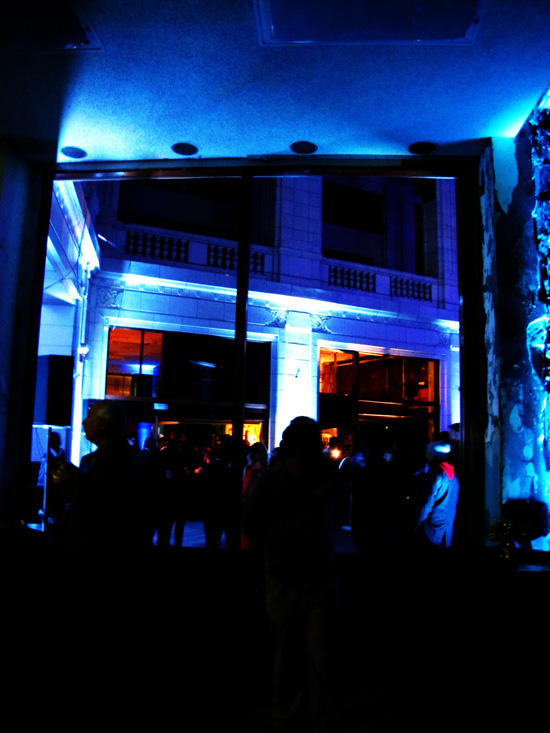
In typical Detroit rogue fashion, this event was being held at the (vacant) David Whitney Building, an 18 story Daniel Burnham designed fortress in the heart of downtown Detroit. Interestingly, Occupy Detroit was camped out (literally, in tents) in the park across the street.
The beautiful terra cotta building is highlighted by a grand 4 story atrium in the center. Despite having no heat and no running water apparently (there were heated outhouses stationed outside the building), the Slow's BBQ and Mac-n-Cheese comfort foods, open bar with specialty drinks and throngs of people kept things warm. Mostly.


The space hosted a variety of "street art," both created for the event (by Street Culture Mash artist Mike Han) and already existing.


What's interesting is that it reminded me strangely of our Nosh Night Sketch Off event last year, in McKay Tower (Grand Rapids):

Being cold and jostled around in a mass of people gets old after a while (we were bored), so Tommy recommended we head over to Cafe D'Mongos, an historic speakeasy about a block away. There we listened to some great live piano jazz, barbecued soul food including collared greens, and got totally absorbed into the overstuffed chairs and overpacked walls.


From there Juliet found out that a friend of hers, who is on the legal team for Insane Clown Posse, was hanging out with friends at a karoake bar in Ferndale. I didn't manage to get any pictures, but the night did take a turn for the better, including a really really bad version of Counting Crows' "Round Here" (not by anyone in our party), discussions of an old mining town in Pennsylvania that has had underground fires for over 40 years, and porn star conventions in New Jersey.
Thank you Detroit. I have yet to have a bad time in your grand old city.
Saturday, October 15, 2011
Exercise in Contrasts
It's hard to remember a time when I wasn't an avid cyclist. But in fact, it was February of 2010 when I injured myself running and had to switch to another way of getting a workout. I remember the pain (of what I am convinced was a hairline fracture) very well. It was as if someone were cutting a hot wire across my ankle bone; nothing like shin splints that I've had before. I thought "I'll probably never run again."
Luckily I was able to get access to a recumbent stationary bike to keep my 3/4 days a week workouts going. I even felt like I was getting pretty good at it, and trumpeted my puny little advances on Facebook. This led to a discussion with someone active in JDRF locally (our daughter has Juvenile Diabetes) who talked me into going to an informational meeting about the JDRF Rides to Cure Diabetes, century rides in multiple areas around the United States. I did one in Death Valley 7 months later and a new passion was born.
Jump forward to mid October 2011 for a minute
My typical ride this Fall has been about 20 miles, which takes me a little over an hour to complete. I'd occasionally throw in a 30 mile ride if I had the time on the weekends. I've gotten my cruising speed on flat terrain up to 18 - 22 mph. It used to madden me to be trucking along as fast as I could go (about 16 mph) and have guys passing me as if I were standing still. But my conditioning has improved tremendously this year.
I even did a route last week that I haven't done in a long time, and distinctly noticed that uphill stretches that really caused me a lot of pain in the past now just passed without much fanfare, and me barely out of breath. But after doing a grueling 45 mile ride this Summer in Antrim County that included climbing passes through Schuss and Shanty Creek Mountains, all those hills in Ada now seem pretty weak.
Moving Indoors
For some reason this year's transition to riding indoors is a lot harder for me. I've only been riding outdoors since about early April, but in those 7 months I've ridden almost 2000 miles, ON THE ROAD. I've seen much of Northeast Kent County. I've been to Lowell, Rockford, Cedar Springs, and Sand Lake. I've pedaled through Holland, Fennville, South Haven, Douglas, and Saugatuck. I've rolled through Torch River, Kewadin, the town of Torch Lake, Eastport, Central Lake, Bellaire, Alden and Clam River. I rode the 45 miles around Torch Lake, a ride I never thought in a million years would be possible, twice this Summer. I rode my first Grand Cycling Classic in downtown Grand Rapids and felt the first real, albeit small taste of bike racing on an urban track. I even had a train of riders hook on behind me in my last lap.
I bought "leg warmers" to keep my legs warm for riding in cooler weather, which are really just spandex thigh to ankle tights that make you look like Batman. The guy at the bike store told me that when the temps drop to 60 or below, you really need to keep your knees warm when biking. So I bought em.
But alas, with darkness coming earlier in the evening (when I usually ride) and the weather becoming more unpredictable, it's just about that time. I know there will be some people who bicycle commute who will say I'm a wimp, but whatevs.

That's my setup: a Cyclops bike stand, a fan and a TV with built in DVD player. Although that bike is actually a loaner I had for a short period of time. Mine is a Trek 1.5, similar style but not nearly as much carbon as that sweet Cervelo in the picture. In order to make riding indoors more palatable, I used a $100 gift card I had for Amazon.com and ordered the eRock Rocks virtual century ride set of DVD's.
What's the point of all this rambling? Who knows. But I wanted to share that I went from basically a non-cyclist to a 3000 mile a year rider in less than 2 years. And my waistline went from a 38 to a 34 in the same time period. I didn't play sports in high school and I've never thought of myself as "athletic." I also read recently that if you enjoy writing, then you should just write more, as much as possible, just like working out. Exercise your writing muscles.
With two century rides and a "classic" race under my belt, I'm trying to decide what's on the horizon for next year. If I can just get through this painful couple of months of riding in the basement. Maybe we'll get another warmup in the next few weeks...
Sunday, March 6, 2011
Brown vs. Green: The End of Brownfield Redevelopment?

This blog entry was run Feb. 23rd in Rapid Growth Media.
Our new Governor, Rick Snyder, has said that "everything is on the table" for cuts in the upcoming budget, including cuts to the State's very successful Brownfield Redevelopment Tax Credits. But at a time when the State is trying to create jobs, be more efficient, and be more business-friendly, is doing away with these credits a smart move?
Making stuff is sometimes dirty work
I'm sure you've heard this story before: Grand Rapids has a long and rich history in manufacturing, dating back to the mid 1800's and the rise of the furniture industry in the Grand River Valley. It was even minted "Furniture Capital of America" at the turn of the 19th Century, with over 400 furniture makers lined up and down the Grand River and spilling into the surrounding countryside. At its peak, 40% of the workforce in Grand Rapids worked in furniture manufacturing. And making furniture, particularly wood furniture, was a very dirty business.
Long before we cared much about our air and water quality, we spewed tons of toxins into the air, ground and waterways. That practice continued well into the mid 1900's, and still plagues many (predominantly urban) sites not only in Grand Rapids, but all over Michigan and the United States. Cleaning up these contaminated sites is expensive, sometimes litigious, and many of the perpetrators aren't even around anymore.
That's why in the mid 1990's, the State of Michigan and many other states put into place Brownfield Redevelopment Authorities, and created a system of tax credits to help companies offset the costs of redeveloping contaminated industrial sites and old buildings. In many cases, the projects are not even feasible without Brownfield Tax Credits.
It's usually much less expensive in the short term for a company or developer to work with a Greenfield site (traditionally rural and agricultural). In Grand Rapids for instance, the cost of land in downtown has skyrocketed to $3 - $5 Million+ per acre, while land in the suburbs can be picked up for as low as $50,000 per acre. In addition, many old buildings are filled with asbestos and other hazardous materials that prohibit their use without massive and costly cleanup. The "path of least resistance" many times, at least short-term, is to build in the suburbs.
How far we've come
Grand Rapids has made huge strides in the rejuvenation of historically industrial and riverfront areas. That's what a State that has been too dependent on manufacturing for too long is supposed to do, right? According to the City of Grand Rapids, just since 1998, 79 Brownfield Plans were approved, amounting to over $1.5 Billion in investment and 7800 jobs; and not just downtown, but all over the city. They have also brought thousands of new residents to the city.
Many of these projects would not have happened without Brownfield Tax Credits, or they would have happened out in the suburbs or in another State.
Here are just a few projects that used Brownfield Tax Credits:
Women's Health Center, Midtown Village and Park Row Condominiums on Michigan Street, 38 Commerce, City Flats Hotel, American Seating Park, 920/924 Cherry Street (home of ICCF and The Green Well), The Gallery on Fulton, Hopson Flats, The Bicycle Factory, Steelcase Campus reuse on Eastern Avenue, Founders Brewing Company, 632 – 636 Wealthy Street, Mercantile Bank on Leonard Street, Union Square Condominiums, The Fitzgerald, Vern Berry Place on South Division, Goei Center on Butterworth, 201 Monroe (Reserve Wine Bar building), Flat Iron Building on Monroe Center, Harris Lofts, Division Park and Serrano Lofts on South Division, the proposed Urban Market, The JW Marriott Hotel, all of the Seward Avenue area projects on the West Side, the Michigan Hill project including the MSU – CHM Secchia Center, the Custer Office project on Grandville Avenue, Integra Printing on Oak Industrial Drive, CRC Paulstra on Fuller Aveue, Coca Cola on Butterworth and Benteler Automotive, Marie Catrib's and The Center of the Universe on LakeDrive.
Imagine going back in time to 1998 and crossing all of these projects off of Grand Rapids' future. I moved here in 1996; I'm not interested in going back to that. Now imagine all of the projects that could benefit from Brownfield Tax Credits over the next 10 – 15 years, which most likely won't happen if they're done away with. That's what we're saying to the people in Grand Rapids in 2024: No soup for you.
Not only that, but these Brownfield Tax Credits and programs have helped clean up industrial and contaminated sites all over the State, including Benton Harbor, Ludington, Jackson, Muskegon, Detroit, Lansing, Traverse City, Kalamazoo and hundreds more.
Brownfield Tax Credits for Dummies
Here's a simple explanation of how Brownfield Tax Credits work: I own a company that's looking to expand or want to develop a project. I basically have several choices A) build on a Greenfield site, which is generally much cheaper per acre than an urban site, and probably won't need to be cleaned up B) build on a Brownfield site or reuse an old dilapidated building C) not do anything, keep my money for other investments, State gets nothing.
Brownfield Tax credits help make up the difference between building on the Greenfield site and the Brownfield site, and reimburse the company part of their tax liability to help offset the costs of cleaning up the contamination. In other words, you build this project and you'll owe less in taxes to the State than you normally would on the project (or you can sell the tax credits at a discount to other parties to help finance the project) and do the cleanup. If you don't build the project, the State never gets any money, and no economic stimulus occurs. No people are hired, no new residents move into the city, no new tax base is added to the municipality, no contaminated site is cleaned up; you get the picture. Receiving a percentage of something is usually better than 100% of nothing.
Why urban sites matter
Trends show that people are moving to large urban areas, en masse, all over the country. According to several reports out recently, there has been a massive shift of construction from suburban and exurban areas to urban areas, where construction in urban areas has nearly doubled in comparison to suburban areas in many regions.
In 1950, only 30% of the world's population lived in urban areas. By 2050, it's estimated that 70% of the world's population will be part of massive urban networks. Where are these people going to live, if many urban sites are contaminated and economically infeasible to redevelop? And will people make urban areas in Michigan their home?
From an efficiency standpoint, it only makes sense. Why encourage growth in undeveloped Greenfield areas where there is very little infrastructure, when there are scores of previously used parcels already served by water, electricity, sanitary and storm sewer, streets, cable, fiber optics, transit, trash collection, healthcare, school buses, sidewalks, parks and a whole lot more. Even many Kent County Commissioners (acknowledged by the Grand Rapids Press) have come to that same conclusion in the last couple of years with increased support of Purchase of Development Rights in rural areas, to help limit suburban sprawl and refocus development efforts toward existing developed areas.
It's less expensive to the population as a whole to have job density located in the center of the metro area. It makes for shorter commutes for most (which means fewer highways and bridges to build and maintain), allows for increased density that can be served by transit and other infrastructure, and can create the energy that comes from having your workforce concentrated with other similar workers.
And young people are continually being drawn to urban areas that have dense, vibrant urban centers with plenty of housing options, amenities, entertainment, access to transit, and walkable residential areas. In fact, some studies predict the next big housing boom will be precisely in these urban neighborhoods, with millennials looking to snatch up affordable properties in these areas. Will we be ready for them, or will they find better opportunities elsewhere because cleanup costs are too great?
The bottom line
If the secret to economic success was to encourage development far out into rural agricultural areas, than Michigan should be one of the most successful economies in the country. At a time when the State should be looking to save money both short- and long-term, and when the population is not growing, investing in and reusing what we already have seems to make a lot more sense than to subsidize growth in new areas. In addition, it seems like incentives that provide a triple whammy: create jobs, bring in new city residents, and clean up the mess left by generations before us, would appeal to both sides of the aisle.
Monday, December 20, 2010
We need a diabetes research center in Grand Rapids

Enough big numbers for you? How about this last disturbing one: 88,000 amputations are performed every year due to the effects of diabetes on the body’s limbs and extremities.
What’s the difference between Type 1 and Type 2 Diabetes? Though both are very similar in how they affect people, Type 1, also known as Juvenile Diabetes, is hereditary, NOT caused by external factors such as poor diet and lack of exercise, and diagnosed primarily at a very early age. A person with Type 1 is essentially unable to produce insulin him or herself, an important chemical produced in the pancreas to help the body process and regulate sugar levels. Without insulin, the human body cannot handle unprocessed sugars and the person will quickly fall into coma and eventually die. Thus, all insulin must be administered manually and continually 24 hours a day.
Type 2 is generally caused by a number of factors, including poor diet, a sedentary lifestyle, and some hereditary factors. Traditionally it had been mainly diagnosed in adults over 40, giving it the term “adult-onset” diabetes. But today, for the first time in our history, more and more children are developing Type 2 diabetes. Though it doesn’t normally require insulin therapy as intensive as Type 1, it affects far more people in this country and is the fastest growing segment of diabetes.
Complications from a lifetime of diabetes include cataracts, nerve damage, coronary disease, limb amputations, heart disease, strokes and shortened life spans of about 15 years.
Hard to believe that such a ravaging disease has not been cured yet, isn’t it? And it’s getting worse. Work is being done in many parts of the world to find a cure, particularly focusing on an artificial pancreas and pancreas stem cell research for children with Type 1 diabetes. Other extensive research is being put into making lives easier for those who suffer from diabetes, including better management tools and less intrusive monitoring (diabetics require multiple shots and blood checks daily). But more could be done to help find a cure for this disease.
That’s where Grand Rapids comes in.
A cursory search turns up only a handful of major diabetes research facilities in the U.S., far fewer than the number of cancer research centers. With Grand Rapids establishing a major beachhead in the realm of medical research and biotechnology with the Van Andel Institute and its partners on Medical Mile, it seems that now might be the opportune time to carve out a niche in diabetes research; particularly with the estimates that the costs of diabetes to the U.S. economy may double in the next few years. In addition, the possibilities for translational science could be tremendous (turning research into viable business opportunities).

Why not capitalize on the momentum being generated on the Hill, and give us one more reason to celebrate the advancements happening right here that could change the entire world for the better? How do we make this happen?